Good morning
On 25 October 1415, an English army defeated a much larger French force at the Battle of Agincourt, near the village of Azincourt in northern France. Heavy rain had turned the ground to mud, which slowed down the French knights and their horses, while English archers with longbows fired from drier footing nearby.
Today's issue looks at places and maps that surprise people. We cover a country with no low ground, a famous mosque younger than it looks, and a mountain that outranks a more photographed rival.
In today's edition
- A country with no low ground
- A famous mosque younger than the Eiffel Tower
- Asia's tallest peak isn't the famous one
- Two flags almost no one can tell apart
- Reveal a flag one piece at a time
Lesotho · Fact of the day
Lesotho's lowest point is still higher than most mountains
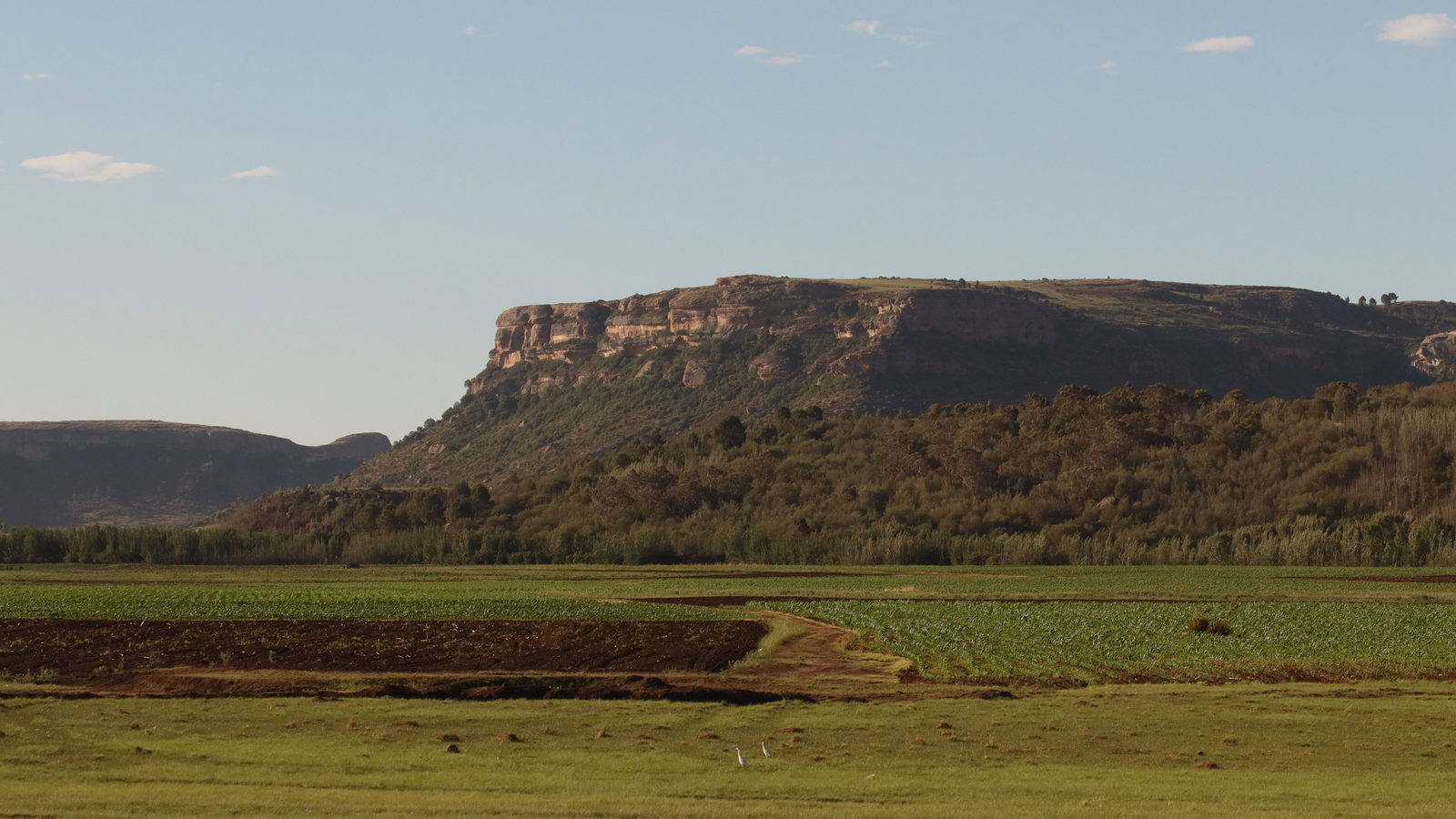
Most countries have some low ground near sea level, even a river valley or a stretch of coast. Lesotho, a small kingdom entirely surrounded by South Africa, does not. Its lowest point, where the Orange and Makhaleng rivers meet, sits about 1,400 metres above sea level. That is roughly the height of a small mountain in many other countries.
This makes Lesotho the only country on Earth whose land never dips below 1,000 metres. The reason is simple: the whole kingdom sits on top of the Drakensberg and Maloti mountain range, a high plateau rising out of southern Africa. There is no lowland to drop into. By contrast, Nepal, home to Mount Everest, also has flat plains near sea level, so its lowest point is just 59 metres up.
↗ Send this fact to a friend13.90° N, 4.26° W · Place of the day
The Great Mosque of Djenné, Mali
The Great Mosque of Djenné stands in the town of Djenné, in central Mali, on the inland floodplain of the Niger River. It is the largest building made of mud brick anywhere in the world, with thick walls of sun-dried earth and wooden beams poking through the plaster. A mosque has stood on this site since the 13th century, but that early building fell into ruin.
The structure visitors see and photograph today was rebuilt in 1906 and 1907, under French colonial administration, by Djenné's local guild of masons. That makes it about 119 years old, younger than the Eiffel Tower in Paris. Every year, the people of Djenné still replaster the entire building by hand during a festival called the crépissage, to repair the damage done by seasonal rains.
 Play today's Worldle
↻ Also on the map
Kyrgyzstan's flag centre is a yurt roof, not a sunflower The yellow shape at the centre of Kyrgyzstan's flag is a tunduk, the wooden roof-crown of a traditional yurt, seen from inside looking up. In 2023, Kyrgyzstan's parliament changed the flag's design slightly because the shape was often mistaken for a sunflower.
Bahrain's flag has five points, Qatar's has nine Bahrain and Qatar each fly a red and white flag with a zigzag edge, so travellers sometimes mix them up. Since 2002, Bahrain's flag has had exactly five white serrated points, compared with nine on Qatar's maroon version.
Between issues
GeoGrid gives you a 3 by 3 grid where each row and column names a category, such as a continent or a shape of border. You pick a country that fits both at once, which makes you think about the map in a different way.
 Play today's GeoGrid
Locate the country
Today's mystery shape could not be added to this issue. You can still play today's Worldle.
Yesterday, revealed
Yesterday's answer could not be added to this issue.
28.26° N, 97.37° E · By the numbers
Southeast Asia's highest mountain is not the famous one
Mount Kinabalu, in Malaysia, is the mountain most people picture when they think of Southeast Asia's highest point, since climbers photograph it often. The true record belongs to Hkakabo Razi, a peak in Kachin State in the far north of Myanmar, at 5,881 metres. That is about 1,800 metres taller than Kinabalu, roughly the height difference between a tall office block and a small hill. Myanmar's far north reaches up into an outlying arm of the Himalayas, which is why the region's roof sits there and not on its best-known peak.
FREE · WEEKLY EMAIL · GEOGRAPHY
Put the world in your inbox.
A new geography brief on the site every day, and one in your inbox every week.
That's the world
See you tomorrow. The Teuteuf team
Sources: Wikipedia: List of elevation extremes by country · UNESCO World Heritage Centre: 'Old Towns of Djenné' (site 116rev), Outstanding Universal Value statement · Eurasianet: 'Kyrgyzstan: Flag-tinkering, another Japarov nation-building exercise' (Ayzirek Imanaliyeva, Bishkek) · Flags of the World (FOTW), 'Bahrain' - vexillological reference citing Album des Pavillons, Bahrain Ministry of Information and contemporaneous Bahrain Tribune / BNA reports · Encyclopaedia Britannica: 'Mount Hkakabo'