Good morning
On 27 November 1095, Pope Urban II stood before a crowd in Clermont, in what is now France. He called for a military expedition to the eastern Mediterranean. His speech set off the First Crusade, sending thousands of people across Europe and Asia over the following years.
Today's issue stays closer to home. We look at a pyramid that held a height record for millennia. We also cover a narrow strait that carries a fifth of the world's oil, and the 15 minutes separating Nepal's clocks from India's.
In today's edition
- The pyramid's long reign as tallest building
- A narrow strait carrying a fifth of oil
- Nepal and India's unusual 15 minute gap
- Two flags with symbols from nature
- Piece together a flag before you know it
Great Pyramid · Fact of the day
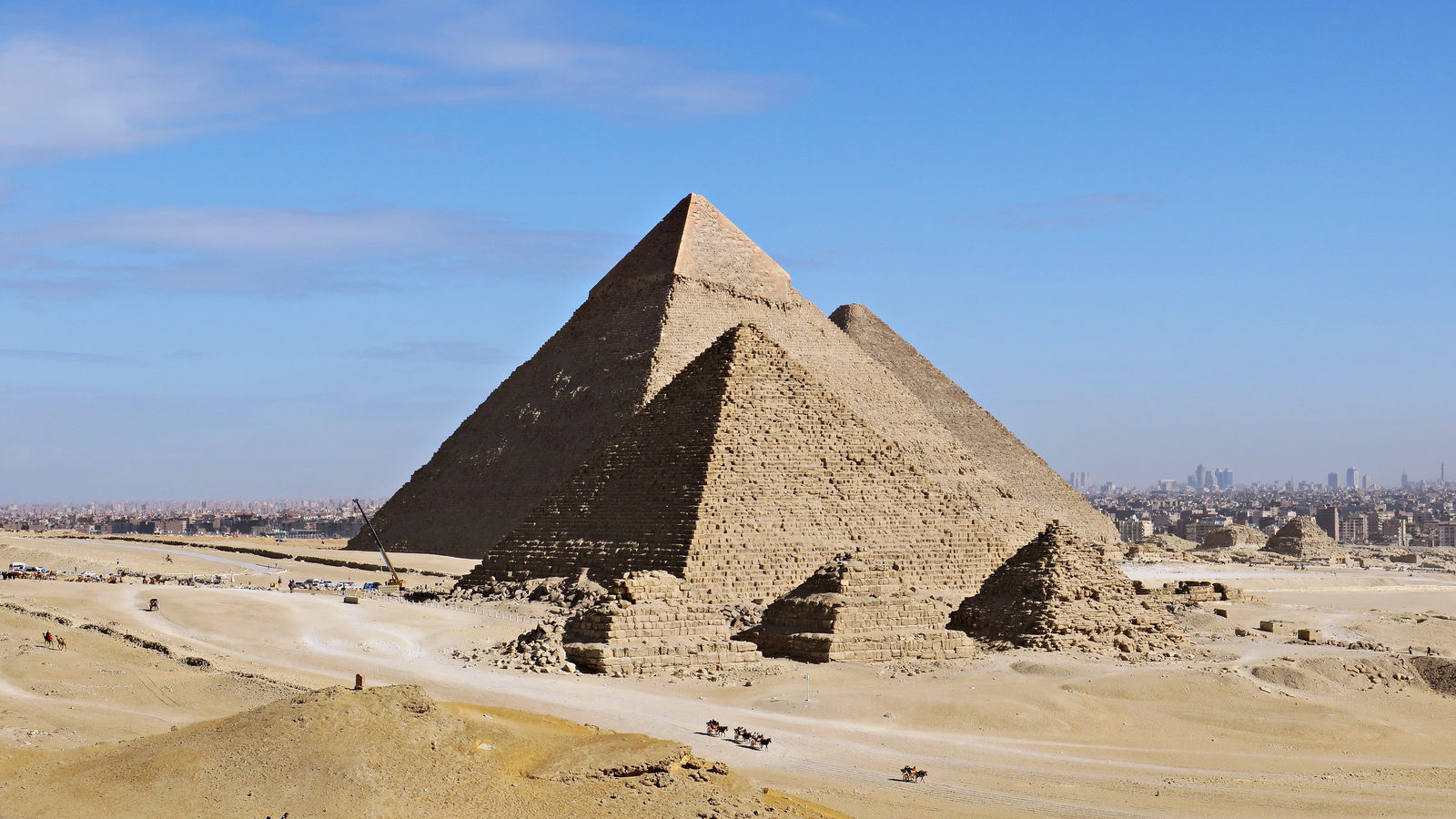
The Great Pyramid was the tallest building on Earth until 1311
Many people assume a much more modern building must hold the record for tallest structure ever built. In fact, the Great Pyramid of Giza, built in Egypt around 2560 BC for King Khufu, kept that title longer than almost anything since.
At 146.5 metres tall when finished, about the height of a 40-storey building, it stayed the tallest human-made structure on Earth until 1311. That is when workers finished the spire of Lincoln Cathedral in England, which reached roughly 160 metres.
The pyramid has lost some of its height since then. Erosion and the removal of its smooth outer stones over the centuries have brought it down to about 137 metres today.
↗ Send this fact to a friend26.12° N, 56.25° E · Place of the day
The Strait of Hormuz
The Strait of Hormuz is a narrow sea passage between Iran and Oman, linking the Persian Gulf to the Arabian Sea and, beyond it, the Indian Ocean. At its narrowest point it is about 33 kilometres across, roughly the distance from one side of a large city to the other.
What makes it unusual is how tightly the shipping is squeezed within that gap. Oil tankers are confined to two one-way lanes, each only about 3 kilometres wide, with a buffer strip of open water kept clear between them.
Through that thin corridor passed about 21 million barrels of oil a day in early 2025, close to a fifth of all the petroleum the world uses.
 Play today's Worldle
↻ Also on the map
Lebanon's flag carries a tree named in the Bible Lebanon's flag, adopted in 1943, has a green cedar tree centred on a white band between two red bands. The cedar of Lebanon is mentioned 103 times in the Bible.
Thailand's flag has a wide blue stripe for a reason Thailand's flag has five horizontal stripes: red, white, blue, white and red, with the middle blue stripe twice as wide as the others. King Rama VI introduced it by decree in 1917.
Between issues
Fancy a different kind of challenge? GeoGrid gives you a 3x3 grid and asks you to name a country that fits both its row and its column, mixing flags, capitals and borders in every square.
 Play today's GeoGrid
Locate the country
Today's mystery shape could not be added to this issue. You can still play today's Worldle.
Yesterday, revealed
Yesterday's answer could not be added to this issue.
27.70° N, 85.32° E · By the numbers
The clocks of Nepal and India
Nepal sets its clocks 45 minutes ahead of Coordinated Universal Time (UTC), the world's reference time. India, right next door, sets its clocks 30 minutes ahead of that same reference. The gap between the two neighbours comes to just 15 minutes, about the length of a short coffee break. It is the smallest time difference between any two neighbouring countries on Earth. Most countries that share a border either keep the same time or differ by a full hour or more. A traveller crossing from India into Nepal barely needs to touch their watch at all, just nudge the minute hand forward a quarter of an hour.
FREE · WEEKLY EMAIL · GEOGRAPHY
Put the world in your inbox.
A new geography brief on the site every day, and one in your inbox every week.
That's the world
See you tomorrow. The Teuteuf team
Sources: Egyptian Ministry of Tourism and Antiquities: "The Great Pyramid" (official monument page) · U.S. Energy Information Administration, Today in Energy: "Three important oil trade chokepoints are located around the Arabian Peninsula" · Encyclopaedia Britannica: "Flag of Lebanon" · Flags of the World (FOTW / CRW Flags): Thailand, quoting the Thai Flag Act B.E. 2522 (1979), Chapter 1, Section 5(1) · Wikipedia: Nepal Standard Time